Saturday, July 14, 2012


Game meats


Eating an anti-aging diet of at least 60% alkaline producing food to 40% acid producing can sometimes be a daunting task.  It helps if you know how to cook.  For those of you who don’t, I recommend you buy my first book, volume one of the Cooking Skills for Life series,  As Good As It Gets.  If you can’t cook from scratch you will be dependent on prepared and processed foods, most of which are acid forming due to high fructose corn syrup, table salt, sugar and refined grains that are in most manufactured packaged foods. 

Since all animal protein and grains are acid producing, it makes it difficult for those of us who are used to eating meals based on them as the center of the plate ingredients, to satisfy our need to eat what we were served when growing up.  Well, we don’t have to give them up and become vegetarians.  We just need to eat fewer and smarter.  Most of us eat far too much protein anyway.  So, it just means instead of an 8 or 12 ounce potion of steak, cut it down to 4 or 5 ounces and load up on a variety of vegetables and alkaline sauces you can make to accompany it like salsa verde, tomato salsa fresca, sauces made from chilis, herbs and fruits like blueberries, figs, lemons and cherries.  There is another way as well, and that is to choose animal protein wisely.  Not all meat is equal.  One of the less acidic varieties is game meats. 

These animals are considered hunting animals, and forage or graze for their food.  Having lived in Maine for 25 years, I am familiar with the meat of the deer and moose, and have on occasion tried bison.  They are all leaner than the traditional meat cuts of beef, lamb and pork.  All three make an excellent chili when cooked in an acid like tomatoes and wine, paired with chili peppers and cooked using a long, slow stewing method.  Rabbit was one of my favorite dishes when growing up, and ever since culinary school I have had a love affair with duck, but I am unfamiliar with the likes of ostrich, elk, alligator, kangaroo and yak.  Although less acidic producing than beef or pork, game meats are still nonetheless on the acid producing side and therefore, like all of the other animal proteins, should be eaten in a portion size equal to the size of your fist, or smaller if you have a fist like mine, and should never equal more than 40% of the plate, even less if grains are included.  And as always, cook and pair the animal protein with as many alkaline forming ingredients as possible.  Here I use chilis, sour cherries, herbs and shitake mushrooms to boost the alkalinity and pair the venison with a plateful of garlic sautéed broccoli rabe and a side of great northern white beans and caramelized onion.

Eat smart, America!

 Chocolate, chili, cherry venison

Yield  :   4 servings          
Preparation Time :  45 minutes 
Cooking Time:  20 minutes

Ingredients

1 1 to 1- 1/2-pound venison loin, cut in two to four equal pieces for more even cooking and more exposed surface for marinating   
2 cups red wine
3 bay leaves
2 sprigs of thyme (remove some leaves for garnish)
1 ancho chili, seeds removed and crumbled
4 cloves of garlic, crushed
4 cups beef stock
1/4 cup dark chocolate (minimum cocoa of 70%)
Sea salt
Crushed black pepper
Garlic granules
Canola oil
16 ounces of shitakes, sliced
Sour cherries, crushed with seed removed
Lemon wedges for garnish

Directions

In a large stainless mixing bowl, combine the wine, bay leaves, thyme, garlic and ancho chili.  Add the meat , cover and marinate in refrigerator overnight.  Turn the pieces part way through.  Remove and pat dry.  Let the venison come to room temperature before cooking.  Do not discard the marinade.

In a sauce pan combine the marinade and beef stock.  Bring it to a boil and let it reduce by half then half again to the desired consistency of a sauce.  Remove the bay leaves, garlic and thyme.  Add the chocolate then puree to blend in the chili.  Stir in the cherries and set the sauce aside, keeping it warm. 

Pat each piece of loin with salt, pepper and garlic granules.  Coat the bottom of a sauté pan with canola oil.  When the oil ripples, add the venison pieces and brown on all sides.  The pan must be hot enough for the meat to sizzle when placed in the oil.  When all sides are caramelized, move the pan into the oven at 425 degrees and roast for 5 to 10 minutes uncovered.  The meat should be served rare on the inside.  Remove it when the temperature reaches 115 degrees and let it rest while the temperature reaches 120.  Cut it into thin slices, against the grain on a diagonal.    

For the mushrooms, add a small amount of canola oil to the same pan.  Cook quickly over high heat and serve.  The mushrooms will pick up all the little bit of caramelized venison from the bottom of the pan. 

Recommended Service:   Make a bed of garlic sautéed broccoli rabe.  Place the venison slices on top, cover with mushrooms and drizzle with chocolate, chili, cherry sauce.  Garnish with thyme leaves and lemon wedges.   Serve with a side of white beans and caramelized onions.  A glass of Zinfandel wine is an excellent accompaniment to the chocolate, chili, cherry venison. 

Buon Appetito e Buona Salute, Chef AngelaB

P.S.Both my first book AS GOOD AS IT GETS, COOKING SKILLS FOR LIFE, VOLUME 1 $ 4.99  and my current book EAT SMART, AMERICA, AN ANTI-AGING DIET PRIMER  $ 2.99 are 


Thursday, July 12, 2012


Corn Fed America!

SODA BELLY
Duck is one of my favorite proteins.  It has the meaty texture of lean beef with a unique, sweet flavor that pairs well with my anti-inflammatory, original fresh salsas and dipping sauces, especially blueberry ginger and peppery raisin.  But my admiration of all things duck does not include foie gras for which a customer asked recently.  Here is a longer version of my response, which I am reprinting from an earlier posting.  For all of you who are trying unsuccessfully to rid yourselves of the fatty middle just above the waistline, this is especially for you.

What do ducks raised for foie gras and Americans have in common?  They are both corn fed.  How are they different?  Ducks are forced to eat it, we do it willingly, happily even, all on our own---corn cereal, corn bread, corn dogs, corn tortillas, corn starch, corn chips and the most consumed of all, high fructose corn syrup.  And, then there’s the corn we can’t see, in soft drinks, fruit and energy drinks, condiments, packaged foods and even in the meat from corn fed animals. 

As a chef, I have known for some time that geese, and more recently ducks, are force fed through a tube resulting intentionally in a diseased, fatty liver ten times the normal size for the production of foie gras.  But, until recently, what I didn’t know was that the food of choice for ensuring the grotesquely fatty liver is---corn.  It doesn’t take a scientific study to draw what is an obvious conclusion.  Hmmm, fatty liver around America’s middle, foie gras, fatty liver, foie gras, fatty liver, foie gras…

Eat smart, America!

Beyond the Bull does not serve any added sugar from corn or any other food sources.  The reference to corn in the above article, is processed corn (not fresh) used to sweeten prepared foods, juices, soda and just about everything boxed, bagged and canned.  Beyond the Bull prepares all menu items from scratch, avoiding all added sugar whether from corn or sugar cane.  

Buon Appetito e Buona Salute, Chef AngelaB

P.S.  My current book Eat Smart, America, an anti-aging diet primer is available now for Kindle on Amazon.  Download it today.


Tuesday, July 10, 2012


The Whiter the Bread


Have you ever heard the old saying the whiter the bread the sooner you’re dead?  Well, just as all old wives tales have some truth to them, so do old sayings.  When I was a child growing up in Connecticut, we lived on what one could describe as a mini farm.  There was a pond with a damn, a pond large enough so that I couldn’t swim to the other side, (at least not before encountering a snapping turtle or two),  a vegetable garden, a chicken coop, and at one time or another, goats and sheep.  As you can see, my parents provided us with fresh, unprocessed food, sometimes canned or frozen which they prepared, and only occasionally did they serve any factory prepared foods from a can, bottle or box, that is until shortly after I was born, the last of four children.
            By that time, foods like tv dinners, Chef Boyardee spaghetti in a can and Wonderbread were staples of the American diet.  As mothers (mine included) went to work outside the home to bring in the second income that would send their kids off to college some day, it was my generation that took to eating spaghetti with red sauce out of a can or a dinner of meatloaf and gravy, with peas and corn and mashed potatoes off of a compartmentalized metal tray set on top of another metal tray in front of the television.  The favorite school lunch was the fluffernutter made with peanut butter, marshmallow fluff and Wonderbread. 
I had no idea at that time, nor did my parents, of course, that feeding my body the fluffernutter resulted in the same effect as feeding my body a six pack of beer, but without the buzz.  There was added sugar in every component of my favorite sandwich of which I continued to eat long into adulthood.
The peanut butter, although it was rich in protein, was made with added sugar and salt.  The marshmallow fluff was corn syrup and the soft white Wonderbread was made from refined flour, flour that had been chemically bleached, stripped of all nutrients including fiber, then enriched in the manufacturing process by adding salt, sugar, vitamins and finally gluten enhanced to obtain the doughy consistency.  When we feed our bodies foods made primarily with refined flour, such as pasta, pancakes, pie crust, flour tortillas, biscuits, pizza, pretzels, cakes, cookies, and foods that are battered or dredged for that crispy outer skin, we may as well replace them all with Wonderbread.  No wonder laxatives and stool softeners are such a big business in the U.S.  
The world wide web is a wonderful source of information, even more so than going to a reference library in any major city.  However, there is no such thing as modern day internet information police, no one to say, whoa, if you break the law by publishing untruths under the guise of fact, you go to jail.  No, in this amazing America, we have the freedom to do just that, publish untruths, that is.  For that reason, it is reader beware.  
I was recently disappointed by a site that generally gives good advice regarding nutrition, when I read an article that argued the merits of dining on foods made with enriched all purpose white flour.  The article argued that using the enriched flour would give you the important b vitamins (added back in) that you might otherwise be missing from your diet. 
What it did not mention was that eating foods made from refined flour (enriched or not) which has no fiber to slow the digestive process, has an immediate effect on blood sugar level.  Because there is no fiber to slow down the release of sugar, the body responds to the spike in sugar by releasing insulin.  The insulin secreted by the pancreas does its job, reducing the blood sugar level which then causes a tired feeling and makes the person crave more sugar.  Eventually the cycle results in overload to the pancreas, weight gain, obesity and diabetes.  The more refined the carbohydrate, the faster the release of sugar and insulin, the higher and lower the peaks and valleys of energy and mood. 
This is the same cycle for all refined grains, all grains that have been stripped of their fiber, not just refined wheat for white flour, but for refined corn, oats, rice, barley, and rye as well.  As of the writing of this book, I am replacing the old slogan the whiter the bread, the sooner you’re dead, with a new one, the more refined, the bigger the behind.  
More information on anti-aging gastronomy can be found in my latest ebook for Kindle now available on Amazon http://www.amazon.com/Smart-America-anti-aging-primer-ebook/dp/B008H76MAK/ref=sr_1_2?ie=UTF8&qid=1341931244&sr=8-2&keywords=eat+smart%2C+america

Buon Appetito e Buona Salute, Chef Angela B

Thursday, July 5, 2012


Fight Hot Weather Inflammation!


Yes, this blog is all about anti-aging gastronomy, but the fact is that not only does acid forming food cause inflammation, but other forces outside our bodies as well.  One of those is the weather.  I am not referring to the old wives tales about joint pain forecasting storms or an impending cold front, although old wives tales are always based on some truth.  No, I am talking about the extreme hot temperatures plaguing our nation recently.  Here in the upstate of South Carolina, the temperature has been hovering around 102.

Having moved to the upstate from southern Maine via Charleston, SC, I expected that it would take my body a few years to adjust to the climate.  Well, it has been more than a few years, four years to be exact, and I still cannot step outside for more than a few minutes at a time when the mercury rises above 95.  Why?  Not because I sweat or sunburn easily (which I do) or feel faint or show any signs of heat stroke or exhaustion, nothing that ordinary.  It is because whenever I step outside in temperatures that rise above 95, my bones ache.  Okay, they don’t really ache, but it sure feels like they do.

Stress causes inflammation and exacerbates the symptoms of inflammation.  So, for anyone whose body has an inflammatory process going on whether in the form of an immune deficiency disease, a response to an infection,  joint swelling or an old injury such as a stress fracture,  the heat will cause a flare up---more severe symptoms, anything from mild pain to difficulty breathing.  That is why my bones ache. 

Flare up is an appropriate word considering what the extreme temperature can do to the body.  My first summer in Charleston, I visited my primary care physician on at least four occasions with headache, body aches, swelling at the sites of old ankle and knee injuries and what I felt was a low grade fever, always leaving without a prescription and with a lecture about staying out of the sun.  To me, staying out of the sun meant wearing a hat when going outside, which I did.  Finally on the fourth visit, I asked her why I always felt like I had a fever and she responded with, “This is the south.  You’re living in Charleston which is a tropical swamp.  The normal body temperature here in the summer is 99.2, not 98.6.”  That explained everything.

Now, living in the upstate, I am no longer in a swamp, but the heat is just as severe.  The difference is that I have learned ways to cool my internal temperature and prevent the stress to my body.  To southerners who have lived here all their lives, it is common sense, but to someone from Maine, it still takes a concerted effort to remember these five steps to keep the body cool and stave off the stress that stokes the flames of inflammation.

Drink ice water and lots of it.
Seems like common sense.  Not to me.  I never drank water with ice in it---too cold.  But, here you need the ice to cool down your core according to the long time residents of James Island.  So, ice water it is!

Take breaks before you need them.
Don’t wait until you feel sick or so hot you can hardly walk to take a break.  And by take a break I mean get out of the heat and into the AC.  The hotter the temperature, the more frequent the breaks, so today, with the temperature at 98 in the shade, ten minutes at a time for picking vegetables was enough for me.

Slow down.
That means slow your movements.  Don't run, walk!

Stay inside.
If you don't have to leave the AC, whether in your car, office or home, don't.  There is plenty that can be done indoors when the temperature soars.

Eat.
Even though you don't fell like it, you still need to eat.  Limit your diet to the alkaline producing foods like cucumbers, tomatoes, grapefruits, watermelon and lots of greens for their high water content and their ability to keep your blood glucose even throughout the day.  Add small amounts of protein with some healthy fat from omega 3.  Extra salt and sugar are not recommended which means on a day like today, Red Bull is not your friend.


Eat smart and stay cool, America!


Buon Appetito e Buona Salute, Chef AngelaB

P.S.  My current book Eat Smart, America, an anti-aging diet primer is available now for Kindle on Amazon 

 All proceeds from my books will be used to open the first EAT SMART restaurant to serve anti aging gastronomy in the upstate SC.    I am 75% of the way there with funding.  Every book I sell gets me one tiny step closer.  For your support and generosity---thank you. 


Wednesday, July 4, 2012


Happy Fourth of July, America!

Not only am I celebrating my American heritage independence from the tyranny of the oppressive British rule, but on this fourth of July, I am proud to celebrate my independence from bad food---hot dogs, hamburgers and white buns, macaroni salad, ice cream and cake.  Instead, our picnic this year is tomato and cucumber salad, corn on the cob, skewered chicken, lamb kabobs, marinated green beans and dark chocolate chili frozen pot de crème (on a stick for the kids!)

And, I am also celebrating the release of my latest ebook for Kindle, EAT SMART, AMERICA---having just gotten the word from Amazon.  This one is a prequel to the next in my series of Cooking Skills for Life, Volume 2, Good Food Bad Food to be released in August.  Eat Smart, America---an anti-aging diet primer introduces the reader to a way of eating that reduces inflammation in the body and therefore, reduces the risk for age related chronic disease. 

Those of you who have been following me on this blog and on my facebook page know that I firmly believe that all age related chronic disease is the result of inflammation, a result of a diet high in inflammatory foods---meat, dairy, refined grains and sugar.  I practice what I preach and have enjoyed the benefits of eating a diet rich in alkaline producing foods---foods which have rid me of those same age related symptoms of pre- diabetes, pre, cholesterolemia, pre-hypothyroid, joint and muscle aches and pains, psoriasis, dry skin, and on and on and on, that we all expect as we age.  Well, it doesn’t have to be that way.  Eat Smart, America will show you the way it should be!

Lastly, due to eating a diet rich in alkaline producing food, I am celebrating my independence from prescription drugs, medical offices, anti-inflammatories, antihistamines and decongestants.  Eat smart, America!


Buon Appetito e Buona Salute, Chef AngelaB

P.S.  My current book As Good As It Gets  which teaches the basic cooking methods you need to cook fresh foods from scratch is also available now at  http://www.amazon.com/As-Good-It-Gets-Cooking/dp/1477466886/ref=sr_1_1?ie=UTF8&qid=1338323791&sr=8-1.  All proceeds from my books will be used to open the first EAT SMART restaurant to serve anti aging gastronomy in the upstate SC.    I am 75% of the way there with funding.  Every book I sell gets me one tiny step closer.  For your support and generosity---thank you.  

Monday, July 2, 2012


Sugar is Sugar…all equally bad!


Sugar is sugar.   A true statement, one that is used as a marketing tool to convince the viewer of the television advertisement that corn sugar, the new moniker for what was previously known consumer wide as high fructose corn syrup, is simply nature’s sugar in another form.  Whether it is corn sugar or cane sugar, the body doesn’t know the difference, says the actor posing as a concerned parent as he strolls through the corn fields while his school age daughter holds onto his hand and skips alongside.  Using a clever framing technique, the producers get the viewer to make the decision that if corn sugar is the same as cane sugar, then it follows that high fructose corn syrup is okay for our kids. 
Well, they are right about one thing.  Sugar is sugar.  Whether it is high fructose corn syrup, corn sugar, natural sugar in the raw, brown sugar, beet or cane sugar, or the refined white sugar in just about every cake and cookie in the world, they are all equally bad.
It is hard to believe, but there are still medical doctors practicing today who claim weight gain is the result of consuming too many calories, more calories than can be used by the body.  It is the old calories in, calories out mantra.  Therefore, according to them, to maintain or lose weight, all one has to do is consume fewer calories than the body can use.  If that were true, I should be able to eat all of my calories in sugar and as long as the total caloric intake is less than what I can use, I should lose weight.   Simple, right?  No, it isn’t.  After decades of yoyo dieting I can give you plenty of anecdotal evidence from my own experience that not only is it not that simple, but it is also not true.  Not all calories are created equal.   The body uses different foods for different purposes and with different processing methods and results. 
Take sugar, for instance.  Not all sugar calories are created equal.  More specifically let’s compare the following two sugars, an added sugar (regular white refined table sugar) one that is added to foods either by you or the processor, such as a pop tart manufacturer, and the natural sugar in a potato.  The regular white refined table sugar is sucrose consisting of half glucose and half fructose and the sugar in a carbohydrate such as potatoes is 100% glucose.  The difference between 100 calories of sucrose and 100 calories of glucose is in how the body metabolizes each.
The fructose in the 100 calories of table sugar that you consume is processed by the liver, whereas the 100 calories of sugar in the potatoes is processed by all of the cells in the body.  In the case of glucose from the potato, with the help of insulin, the body allows the glucose to enter into the cells to be used for energy.  When there is too much glucose, it is stored as fat.  That is where one problem lies.  In the case of fructose, if the amount or rate at which the fructose hits the liver is too much for it to handle, the liver converts the fructose to fat.  That is where another problem lies. 
The difference, however,  is that most people eat potatoes only a few times a week and can certainly use the energy and prevent the conversion to fat.  But, when you down a quart of cola or sweetened fruit juice several times a day, the fructose in liquid form hits the liver immediately and if the rate at which the liver has to convert the fructose is more than the body needs, which is usually the case with soda drinkers, again the liver converts the fructose to fat.  The result is weight gain, a fatty liver and insulin resistance, one form of adult onset diabetes. 

You know that hard to get rid of fat around the middle?  That happens to be where the fatty liver lives.  Eliminate sugar and watch it disappear!   Hmmm, perhaps that explains why women who love their bottle of wine have the same middle profile as the men who love their case of beer and the preteens and teenagers who love their six packs of soda. 
What else besides table sugar is made up of fructose and glucose?  High fructose corn syrup, slightly higher in fructose for extra sweetness, was intentionally developed to mimic the sweetness of table sugar.  Calories in, calories out?  No.  All calories are not the same. 
Now that you know that table sugar and high fructose corn syrup are almost identical and both are equally bad foods, what do you do about it?  You avoid it.  I know that you would not feed Fido a chocolate bar which is toxic to canines, so why would you feed your own body sugar, which is equally toxic.  You should, in fact, avoid all added sugar including that which is expressly labeled on prepared foods whether the label reads sugar, cane sugar, high fructose corn syrup, corn sugar or anything that ends with the letters ose. 
Unless the prepared food has been specifically produced for diabetics, you can be certain that there is sugar lurking somewhere in the ingredients.  Some of the sneakiest offenders are condiments like relish, ketchup, salsa, pickled foods, salad dressings, sauces, jams and jellies, all laced with sugar.  Kool aid, sweetened iced tea, powdered fruit drinks, soda, energy drinks and punch are loaded with sugar as are most prepared baked goods, crackers and chips. 
So what can you do if you are a southern belle who loves her sweet tea or a football fan who loves his sports drinks?  That’s what my next book Good FoodBad Food, Cooking Skills for Life, Volume 2, is all about, finding a feel good food substitute to protect your body from the long term ill effects of bad food like sugar.  The book is due to be out on Amazon in August.  Watch for it!

Buon Appetito e Buona Salute, Chef AngelaB

  P.S.  The first in my series of Cooking Skills for Life, Volume 1, As Good As It Gets, is on sale now at Amazon. http://www.amazon.com/As-Good-It-Gets-Cooking/dp/1477466886/ref=sr_1_1?ie=UTF8&qid=1338323791&sr=8-1   All proceeds will be used toward opening the first eat smart restaurant in upstate SC, first to serve a menu of anti-aging gastronomy.  Thank you for your interest and support.  EAT SMART, AMERICA!


Saturday, June 30, 2012


Good Food Bad Food…

a primer for the anti-aging gastronomy neophyte

 Thereis good food and there is bad food.  There is food that when consumed will nourish our bodies, make our hair and skin glow, our fingernails and teeth strong, our bones straight and our eyes bright.  Good food makes us think quicker, see better, run faster, grow taller, move with grace and live longer with a high degree of wellness. 
What, then, does bad food do?  When we consume bad food, our bodies are not nourished, our cells are deprived and our organs pay the price.    Consuming bad food results in inflammation, fat building, malnutrition, bad skin, bones, teeth, hair and nails, slow thinking, aching joints and eventual age related chronic disease.  All of which is preventable.  You could say that healthcare reform begins in your kitchen.   
If you are reading this blog, I assume that you have the same interest as I have in the benefits of preparing and eating foods that keep us young, foods that slow the aging process.   The aging process to which I refer is cellular aging, a complicated process of cell replication that takes place in our bodies as new cells replace old.  But, simply put, cellular aging was once described to me in this way.   Think of your favorite photograph, a self portrait of you at your best.  Now make a photocopy.  You can see that it is not exactly as perfect as the original.  Now take the copy and make another copy.  You can see this one is even less perfect than the second one.  The sharpness dulls, the contrasts lessen.  Now take that copy and make another copy and so forth and so on.  That is what happens to our cells as they replicate.
So, you can see that if we cause our cells to become damaged or imperfect, as they replicate, the damage and imperfections are magnified time and again.   That is why at fourteen years old we feel well and physically fit eating a diet of hamburgers and fries, but at forty-four years old, our arteries are lined with plaque, our joints ache and our fasting glucose has risen from 85 to 115, a mere one point per year.  Who would notice?
I noticed, first, in my forties when I began to experience osteoarthritis, then in my fifties when I began to experience swelling in my ankles and pain in my back, and finally nearing sixty, when my medical history described me as pre obese, pre diabetic, pre hypertensive, pre high cholesterol, and pre hypothyroid.   I was suffering from symptoms of non specific origin (although my physicians were quick to assign labels such as adult onset diabetes, hypercholesterolemia, hypothyroidism, adult onset asthma, psoriatic arthritis, rheumatoid arthritis, and pseudo gout), symptoms that included swelling in knees, fingers and ankles, muscle pain, extreme fatigue, chronic sinusitis, hair loss, dry skin, occasional short term memory loss as I searched for  forgotten words.  I was prone to skin infections and my weight had ballooned out of control.  I had none of these problems in my past history. 
Always the skeptic, I rejected my physician’s offer of pharmaceuticals, one for each of the symptoms, his glib assessment that my symptoms were part of the inevitable aging process and his advice to accept it as a natural part of life.  Instead, I took the advice of my wise and learned chiropractor, Dr. Eleanor Rolnick, who gently but persistently advocated for nutrition as a remedy.   Her advice, her patient and outstanding care and the concern and attention of her staff (and by that I mean her Girl Friday, Pam Gaudette) started me on a path to wellness.  Thank you, my friends.
As a chef educator I have had the experience of teaching in our public schools, teaching young adults how to cook.  We are all aware of the obesity epidemic and the rapid increase of adult onset diabetes and assume it is the result of fast food giants and soda pop. It is, but not that alone. It is also the fault of the parent who prepares quick fix foods, the pop tarts, hamburger helper and pizza, sandwiches with 12 oz of meat and 6 oz of cheese, refined flour products, and all the over salted over sweetened foods from quick service restaurants.  These are the foods my students dined on every day.    
Even the weight conscious teens, the young women especially,  who strive to be model thin and are told to eat less meat, more pasta, salad and cheese, even they are at risk.  Alfredo anyone?  Do you know what a fig is, or what tortilla chips are made from or have you ever roasted a red beet?  "What's a beet", one of my students asked. 
 It didn’t take much research for me to discover the connection between my years of feasting on the western diet of meat and bread, meat and pasta, pasta and cheese and cheese and bread and my burgeoning weight.  I was convinced that my adult onset symptoms were also, in fact, the result of years of consuming inflammatory foods even when I thought I was dieting. 
Diets like Atkins, the Zone, South Beach, and the Mediterranean diets successfully led to weight loss, but you talk about yoyo diet.  That was me, down ten, up five, down five up ten.  Never once did it occur to me that the whole time that I was feeding my body food to lose weight, what I was really losing was my health.  Yes, most of these diets encourage fewer carbohydrates, but they recommend replacing them with excess meat and dairy.  Or, they discourage fat, eliminating meats and replacing them with grains.  In either case, these inflammatory foods accelerate cellular aging. 
The only publicized diet that I know of that resembles the anti aging diet is one followed by my older sister, Michael’s mother, who like her son, at age eight was diagnosed with juvenile diabetes.  After 60 years of eating good food, she now looks 10 years younger than me, is far more physically fit and is never bothered by the nagging aches and pains that I battled for decades. 
The diabetic diet may not be referred to as anti aging or anti inflammatory, but that is exactly what it is.  The same foods that are considered to be inflammatory are the foods that also cause havoc with how our body processes sugars which in turn causes more inflammation and symptoms of disease.  So, whether it is called the diabetic diet, the anti inflammatory diet, the anti aging diet, or even the alkaline acid diet, it is one in the same. 
Based on the principle that foods which are alkaline producing are also anti inflammatory (good foods that promote wellness and therefore are anti –aging) and those that are acid producing are inflammatory (bad foods which promote cellular aging), I embarked on a dietary change that lead to my recovery.  Alkalinity and acidity, the ph to which I am referring is not the ph of the food itself, but the ph of the food after it is metabolized by the body.  So, for example, a lemon has an acidic ph, but when processed in the body it is alkaline forming.  Don’t confuse the two.  There are dozens of websites that explain in detail the science behind the acid or alkaline diet including lists of foods with their corresponding ph as the result of the metabolic process in the body.  Do your own research, and you will find that they correlate with lists of anti inflammatory vs inflammatory foods as well. 
Eating a diet that consisted of at least 60% alkaline producing foods had a dramatic effect.  My blood glucose returned to 85 and my hypothyroidism disappeared along with all of the other age related symptoms.  And although it was not the goal of my new anti-aging dietary habits, my weight dropped considerably as well. 
As time went on and I became more accustomed to eating and preparing an assortment of vegetables, the  proportion of alkaline producing food was easily bumped up to 70% and 75% simply by adding alkaline producing garnishes such as almonds or sunflower seeds, sprouts, chili pepper flakes or my own sauces like blueberry ginger chutney or cilantro salsa verde.  It was not a matter of counting calories or weighing out portions to reach those proportions, but much simpler.  It was just how much of my plate was covered with what type of food.  As long as more than half of my plate was filled with alkaline producing food, I was good to go. 
Here’s an example.  The dinner plate of a typical western diet is a center of the plate meat such as steak, pork or ham (takes up ½ of the plate) with a sauce, splash of ketchup or applesauce, mashed potatoes (1/4 to ½ of the plate) sprinkled with cheese and a spoonful of peas (or none at all).  The dinner plate of a typical anti aging diet is a portion of protein such as chicken equal to about 4 oz. (1/4 or less of the plate) topped with fresh chili and cucumber salsa, an even smaller portion of starch, if at all, such as brown rice (1/8 of the plate) garnished with scallions, and the rest of the plate filled with steamed fresh green beans sprinkled with cilantro, and a garden fresh tomato and watercress salad drizzled with canola oil and fresh squeezed lemon.  Our wellness requires a change of mindset from the current concept of center of the plate protein to center of the plate fresh vegetable---from this
Center of the plate short ribs
to this.

Center of the plate green beans
 In addition, it was not a matter of either or, but how alkaline or acidic producing as well.  For example, lemon and watercress are extremely high alkaline producing, while blueberries are alkaline producing but not as high as lemons or watercress.  So, knowing that, there are little tricks to having your cake and eating it too, so to speak.  If I want to indulge myself by having a glass of red wine which is slightly acid producing, I add a big squeeze of fresh lemon juice and throw in the lemon rind as well.  Or if I am craving beef which is highly acid producing, I accompany it with a gigantic watercress salad.
The difficult part at first, was creating interesting, flavorful, and feel good meals without the use of many of our favorites from our western diet.  A hamburger patty and bun is 100% highly acid producing.  Spaghetti and meatballs is 100% highly acid producing as is pizza with pepperoni.   I was raised in an Italian/Scottish household where pasta of some kind was served almost every day unless we were eating beef and barley soup.  What is the food group with the highest acid producing rating?  Grains!  What is the meat with the highest acid producing rating?  Beef!  This created a challenge for me.
We love our companion pets, primarily ourcats and dogs and wouldn’t think of deliberately feeding them food that causes inflammation or leads to chronic disease.  No, we feed them only the best---the foods that are especially prepared for them to promote shiny coats and bright eyes.  Why, then, do we not do as much for ourselves? 
I can’t go back and redo my youth, undo the harm that has been done, but I can go forward and continue reaping the benefits of eating an anti-aging diet, one that is rich in good foods---foods that are anti-inflammatory, promote wellness and reduce my risks for age related chronic disease like heart disease, arthritis and diabetes.   And, I can teach others to do the same. 

Buon Appetito e Buona Salute,  Chef AngelaB

P.S.   You can purchase As Good As It Gets, Cooking Skills for Life, Volume 1  
available on Amazon now...
 All proceeds from the sale of my books will be used to open the first EAT SMART restaurant in the upstate SC the first to offer anti-aging gastronomy.


Friday, June 29, 2012


A Cucumber A Day Keeps The Doctor Away


Grow cucumbers on wire
fencing for easier picking
Cucumbers have the highest alkaline forming rating of all the vegetables available in your local grocer or your  backyard garden, so eat them as often as you can and any way you can.  My favorite way is to pluck them off the vine and eat them as a snack.  A cucumber fresh off the vine is crunchy and sweet and cool---cool as a cucumber.  But, cucumbers also pair well in condiments with the heat from chilis and spices, and they are excellent alkaline boosters to accompany poultry and fish.  You know the old saying an apple a day keeps the doctor away?  I am officially replacing it with a cucumber a day!  Here are five ways to use cukes in your daily meal planning, each starring the smartest of all vegetables---the cucumber.   Eat smart, America!

 1.       Cucumber dip

             Dice a cucumber, add a dollop of Greek yogurt, a few jalapeno slices, cilantro and an avocado.  Blend until smooth and use it to dip crudités or whole grain pita wedges.

          2.        Cucumber soup 

            In the blender combine mint, cucumber, chicken stock, and goat cheese for a cool as a cucumber refreshing chilled soup starter before any meal.

3.       Chopped cucumber salad

Cucumbers can be sliced, diced, curled or rough chopped and make an eat smart salad when paired with radish, tomatoes, basil, with or without a goat cheese garnish.  Even on their own, they are perfect with fresh herbs and a sprinkle of oil and lemon.

4.       Cucumber condiments 

             Ice box pickles are easy to make with no cooking required.  Just pack cucumber slices in a jar of cider vinegar, a little brown sugar, some onion and celery.  Add celery seed, mustard seed, a pinch of sea salt and refrigerate.    Or for a zesty cucumber salsa follow my recipe below.
A cucumber a day
keeps the doctor away!


5.       Wholey cucumber

            The perfect snack food eaten whole! 

Cucumber jalapeno salsa 

This recipe yields 6 cups.  Cucumbers don’t last very long in the refrigerator once cut so make only what you can eat a day or two at a time.

Yield:   Approximately 6 cups          
Preparation Time:  20 minutes 
Cooking Time:  0

Ingredients

3 each cucumber, Mexican, small dice, peel on
2 each jalapeno, brunois
1 cup corn, frozen whole kernel
4 each scalliions, diced, green part only
8 sprigs cilantro, fresh, rough chopped
1 cup vinegar, apple cider
1 pinch sea salt
2 tablespoons sugar, dark brown, real molasses
1 each juice and zest of lemon, optional

Directions

Combine apple cider, salt, lemon and sugar and whisk until sugar is dissolve.  Fold in the remaining  ingredients.  Chill and serve.

Recommended Service:  Top off fish or fowl, mix into quinoa as a salad or top off a dinner salad by adding a little oil and cucumber salsa.

Buon Appetito e Buona Salute, Chef AnbelaB


Wednesday, June 27, 2012


Ten Reasons to Eat Smart, America


Eating smart of course means eating a diet based on anti aging gastronomy of which this blog is all about.  Eating a diet based on the 60/40 ratio of alkaline forming to acid forming foods is anti-inflammatory, anti-aging and has multiple benefits.  Here are ten.


No more mood swings

You know the moodiness that plagues you mid morning and mid afternoon and sometimes results in brain fog as well?  Most likely it is from eating sugary, refined grains (cereal and bread) at breakfast and luncheon meals.  When the body gets a load of these, it reacts with a load of insulin.  The result is elevated blood glucose from the sugar (happy, happy) followed by a plunge of blood glucose (grouchy, grouchy) when the insulin does its job.  Eating smart guarantees your family and friends can tolerate you 24/7 with no timeouts in between.  

More energy

Without the mood swings from high and low blood glucose, you will find you have more energy and are more productive at home or at work.  Eating smart results in a constant level of blood glucose where and when it should be in your body to do its work---to energize. 

Higher libido

Naturally, when you feel better all around, the feel-good feeling makes for a higher libido.  There’s no more to say about that!

More awake time

With more energy and clairvoyance, you don’t need to sleep to noon anymore and still wake tired.  Your spouse will be happy to converse with you before your morning caffeine fix and your boss will be pleasantly surprised when you arrive on time.  More awake time means more time with family and friends who can now tolerate you 24/7 with no timeouts in between.

Kick the over the counter meds

You can finally stop taking anti-inflammatories for nagging aches and pains, anti-histamine for allergies and decongestants for stuffy nose and sinus.  Eating smart means eating fewer acid producing foods, foods which cause excess mucus formation in most people resulting in symptoms of sinusitis and congestion.    

Complements from family and friends

After 4 to 6 weeks you will definitely be getting complements from family and friends.  Why?  You will see a difference in hair, skin, and nails.  Hair will be shinier (maybe even thicker since it will no longer be falling out) skin less dry and nails stronger and healthier (no more ridges).  You might not see it in the mirror, but when your long lost cousin turns up to visit after a year or two of absence he will think he came to the wrong address.  Oh, and did I mention that your clothes will fit you better?  Cutting down on sugar and refined grains and increasing vegetables, legumes, seeds and nuts will also result in shedding of the extra pounds around the middle.  That pesky “beer belly” look will slowly fade away.

Reduce risk for age related chronic disease

There may not be scientific evidence that eating a diet based on anti-aging gastronomy reduces the risk of heart disease, joint/autoimmune disease and diabetes II, but there is plenty of anecdotal evidence.  I for one can document my history of success, lowering blood glucose from 109 to 85, correcting my hyperthyroidism, and turning heart disease risk factors from bad to good, not to mention reversing the joint swelling that plagued me since my mid forties.  You won’t need a scientist to prove it to you. 

Longevity

Of course you will live longer without obesity, diabetes II, auto immune disease or heart disease!

Cheaper

Even if you don’t believe eating smart will reduce your risk for chronic disease, who doesn’t want to save money, right?  A meal of 60/40 alkaline producing to acid producing food means that you are eating more vegetables than protein.  Doesn’t a tomato cost less than a chicken leg, a sweet potato less than steak? And when you dine out, eat smart and that will cost you less as well.  Choosing salads and sides over steak and lobster will certainly mean a smaller bill.   

Grow your savings account

How does eating smart mean a bigger savings account?  Here’s how:  fewer medical bills, lower household food expense, no more over the counter drugs to buy, less expensive meals out, less time off work and maybe even more overtime, a second job, who knows?  With all the extra energy you may even want to start a second career. 

I know I said ten, but here’s one more.  Be a role model for your kids.  Childhood obesity and diabetes has been on the rise for decades now and needs to come to an end.  For your kids, eat smart, and they will too.  If you have any more reasons to add, leave them in the comments for all to see.


Buon Appetito e Buona Salute, Chef AngelaB.


Saturday, June 23, 2012

Does Anti-Aging Sell?

Yes, I think it does, but for all the wrong reasons.  For youthful skin?  Yes.  For a better sex life? Yes.  For tighter abs?  Yes.  That's all on the outside, but what about the inside?  Anecdotal evidence, of which there is plenty, strongly suggests that our insides can benefit from anti-aging foods if only we could break our addiction to meat and bread.  The Earl of Sandwich did not do us any favors when he came up with the sandwich, nor did Oscar Mayer with the launch of lunch meats.  And how about all those quick service fast food chains who serve up meals that consist of refined flour, sugar and meat...the all American hamburger.

Since switching to my diet of 60 to 70% alkaline producing foods, I have produced an environment in which my body has dramatically slowed the cellular aging process.  For those of you new to this journal, you can go back to the beginning in the archives and read how this all came about and see for yourself what a diet based on what I refer to as anti-aging gastronomy can do.  Just quickly for the newbies, it reduced my blood glucose from 109 to 85 in just a few months as well as correcting my thyroid and ridding me of the stiffness and joint pain that I dealt with all through middle age and into my fifties.

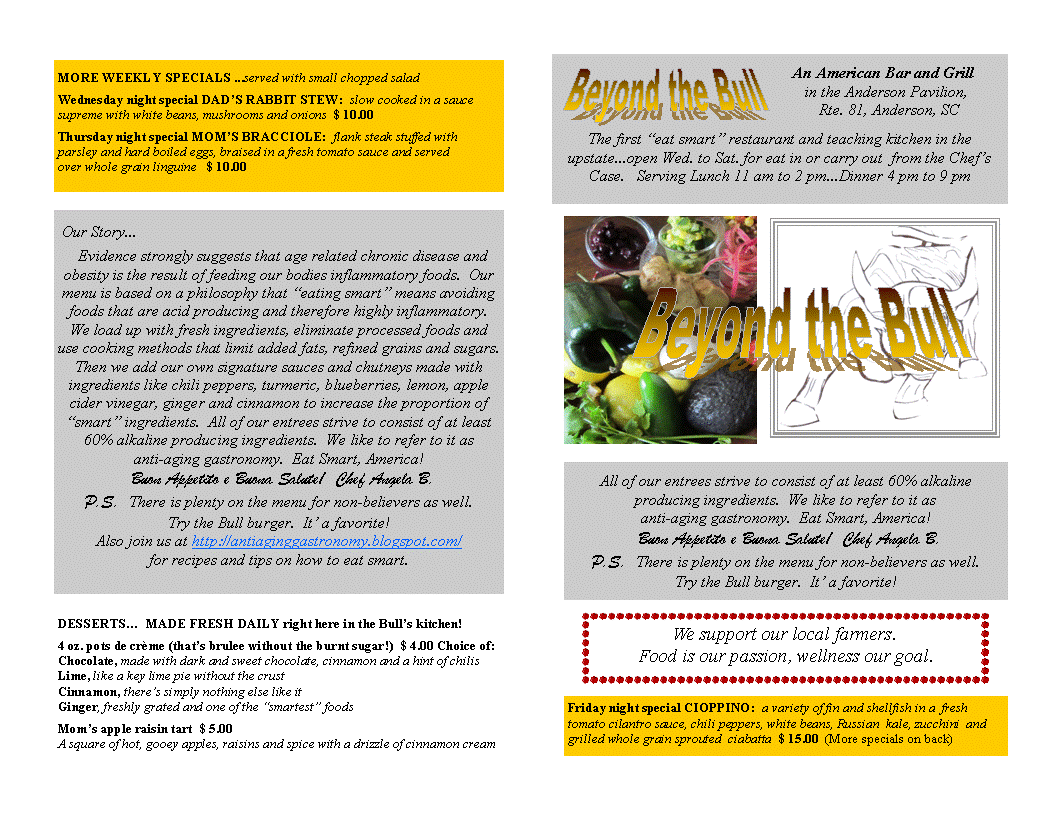
But, anti-aging only seems to sell if it improves the outside of the body, not the inside.  I say this because I have been trying unsuccessfully to get someone to notice my monumental efforts to launch a restaurant in  Anderson, SC in which the menu is based on entrees that are at least 60% alkaline producing food, eliminates added sugar, refined grains and bad fats, and loads up the plates with vegetables and proprietary fresh sauces.  I have been trying to market it as an "eat smart" bar and restaurant in order to raise funding to launch what I think is a most worthy project---an eatery offering Americans who now eat out more than at home, a reasonably priced alternative to the massed produced bad food that leads to age related chronic disease such as diabetes II.  A restaurant that even I would go to, not a health food, whole food or true food restaurant.

I have a dream to open a restaurant in Anderson, SC, a place where Americans are most in love with pig barbecue, hot dogs, deep fried oysters and fried mac n cheese---a restaurant that offers anti-aging gastronomy, not health food, just reversing the proportion of good and bad foods, eliminating sugar, refined grains and bad fats.  It is as easy as that.  I have a dream that I can teach there.  I have a dream that I can offer an incubator for others in the food industry to produce "eat smart" packaged products to help the busy homemaker.  I have a dream that my restaurant will be a footprint for more to spread around the nation so that families can learn to love and even crave good food.  I have a dream that young adults and homemakers will learn from my book series, Cooking Skills for Life, what good food can do, how to prepare it and embrace it with enthusiasm, creating the first generation with fewer diabetics.  The second in the series called Good Food Bad Food will  be available in September.


Yes, I have become an advocate, a zealot for anti-aging gastronomy.  I am because I know first hand that it is the key to our longevity and good health.  It will solve the obesity problem, stop the epidemic of diabetes appearing at a younger and younger age, and make the how to fix our healthcare and health insurance systems arguments go away.  My solution is this:  change the palate of Americans beginning with this generation by offering good food choices where they eat most of their meals,  restaurants.  

The US and SC state government programs (based on US mandates) created for the purpose of eliminating obesity and chronic disease have failed.  Their efforts to educate have failed.  And their new programs to put farmer's markets in the inner cities and make whole food more easily accessible to low income families and welfare mothers will also fail.  It will not put a dent in the metrics.  Americans are hooked on fatty meats, sugar and flour and until the American palate is changed they will walk right past the farm store and into sandwich and ice cream shops, the hamburger chains and meat and three's and step up to the soda machines.  Our tax money is being spent on programs that DO NOT WORK!

I need $ 40,000 to take the first step for America---the first step toward fixing our failing health.  I have
$ 20,000 of my own funds which I have set aside for that purpose.  I just need to match those funds and thus far I have been unsuccessful.  I have been declined for conventional bank loans, SBA guaranteed loans, Angel investors, SC "eat smart" grants, federal grants, went unnoticed on kickstarter and have tried to sell every asset I have without success.  These are hard times for all Americans and Europeans, and I get that.  I want to know from you, my readers in Russia, England, Canada and the U.S.who I know are out there according to the Google stats.

Here is my question, if I list this project on Indiegogo (again), will you contribute $ 20 to help me fund my dream?  If not, I want to know why?  This is not rhetorical, please respond in a comment below.  

Here is a sample menu for you to see what I mean by it is easy to eat smart, America!


.   Buon Appetito e Buona Salute, Chef AngelaB

      https://www.facebook.com/ChefAngelaB